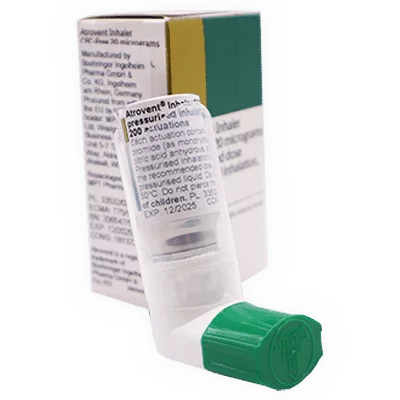
Atrovent is an ipratropium bromide inhaler for adults with COPD and selected asthma. It helps keep the airways open by blocking cholinergic signals that tighten the airway muscles.
Description
Atrovent, containing ipratropium bromide, is a bronchodilator inhaler used to help prevent and relieve bronchospasm in people with COPD (including chronic bronchitis and emphysema) and sometimes asthma. It is for adults who need steadier day‑to‑day airway opening rather than rapid “rescue” relief. The medicine works by blocking cholinergic signals that tighten airway muscles, so airflow improves and breathing feels less restricted.
Composition
Atrovent’s active ingredient is ipratropium bromide (bromura de ipratropium; also written as ipratropium bromid). Ipratropium is an anticholinergic bronchodilator: it blocks muscarinic receptors in the bronchial smooth muscle, reducing vagal (cholinergic) bronchoconstriction.
At a chemical level, ipratropium exists as an ipratropiu cation paired with bromide, which helps keep the drug largely acting locally in the airways after inhalation rather than causing strong whole‑body anticholinergic effects. Pharmacists value that local action because it tends to limit systemic side effects when the inhaler technique is good.
On the ATC system, ipratropium is classified under R (Aparatul respirator). For nasal preparations it appears under R01 (Preparate nazale), including R01A (Decongestionante și alte preparate nazale pentru uz topic), R01AX (Alte preparate nazale), and R01AX03 (Bromură de ipratropiu). The key point for buyers is that the same molecule can be used for different respiratory indications depending on the formulation and route [1].
Dosage and usage
Start with the mechanics. Most failures with inhalers are technique issues, not “weak medicine.”
Typical use principles for Atrovent inhaler
Use Atrovent exactly on the schedule given by your prescriber for COPD/asthma maintenance.
Prime the inhaler before first use by releasing two test puffs into the air.
Re‑prime with two test puffs if the inhaler has not been used for more than three days.
Do not exceed 12 inhalations in 24 hours.
This inhaler is not intended for emergency asthma relief.
Technique that changes the result
Breathe out fully first, away from the mouthpiece.
Seal lips around the mouthpiece and start a slow inhale.
Press the canister once while continuing to inhale slowly and deeply.
Hold your breath for about 10 seconds, then breathe out gently.
Slow inhalation matters. Fast inhalation wastes spray on the throat.
A spacer can reduce throat deposition and the bitter taste for many people, and it often improves lung delivery when coordination is hard.
Try the “mirror check” once: if you see a visible white mist escaping from the sides of your lips, your seal is leaking and dose delivery drops.
How it works
Route: Inhalation only, using the Atrovent inhaler.
Dose: 0.02 mg per actuation (20 micrograms per puff); use the number of inhalations prescribed by the clinician.
Frequency: Typically 3–4 times per day.
Timing: Use at evenly spaced times during the day; if used with other inhaled medicines, take Atrovent first unless told otherwise.
Duration: Use for the prescribed treatment period; do not stop early unless instructed by a clinician.
Administration: Breathe out fully, seal lips around the mouthpiece, inhale slowly and deeply while pressing the canister, then hold the breath for about 10 seconds before exhaling.
Indications
Atrovent is used to help prevent and relieve bronchospasm in people with COPD, including chronic bronchitis and emphysema, and it may also be used in selected asthma treatment plans as an add‑on. It is intended for steadier day‑to‑day airway opening rather than rapid rescue relief.
Comparison
Atrovent — Comparison with Alternatives
Atrovent sits in the short‑acting muscarinic antagonist (SAMA) class. Alternatives differ mainly by duration of action and whether they combine mechanisms.
Option
What it is
Typical place in therapy
Atrovent (ipratropium)
SAMA bronchodilator
Maintenance symptom control in COPD; add‑on in selected asthma plans
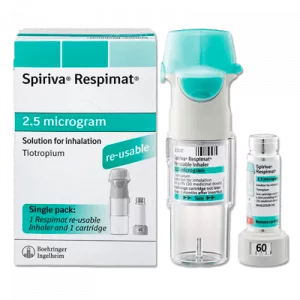
Tiotropium
Long‑acting muscarinic antagonist (LAMA)
Long‑term COPD control; once‑daily style regimens in many plans
When dual bronchodilation is desired for symptom relief
Trade‑offs are real. Longer‑acting anticholinergics can reduce dosing frequency, yet some patients prefer the flexibility of a short‑acting option. Combination products can open airways through two pathways, but may also bring beta‑agonist side effects like tremor or palpitations.
Contraindications
Known allergy to ipratropium, atropine, or atropine-like compounds.
Prior swelling of the face or lips, severe rash, or breathing difficulty after an anticholinergic inhaler.
When this is not for you
If you have narrow-angle glaucoma or eye pressure problems, because spray in the eyes can trigger pain, blurred vision, or halos.
If you have urinary retention or significant trouble passing urine, because anticholinergic medicines can make it worse.
If you notice wheeze or chest tightness that gets worse right after a puff, because that can be paradoxical bronchospasm.
If you have a known allergy to ipratropium, atropine, or similar medicines.
If you have ever had facial swelling, a severe rash, or breathing difficulty after an anticholinergic inhaler.
Side effects
Most people tolerate inhaled ipratropium well, yet side effects are real and worth planning for. Dry mouth is the classic complaint, and a bitter taste after a puff is common; neither usually signals harm, but both can reduce adherence over time. Headache and mild dizziness can occur, and they tend to be more noticeable in the first days.
A rare risk is paradoxical bronchospasm, where breathing feels worse right after inhalation. Treat that as urgent and stop further puffs until you’ve been clinically reviewed. Hypersensitivity reactions (including angioedema or anaphylaxis) are uncommon, but they’re part of the safety profile of inhaled anticholinergics and require immediate medical care if they occur [2].
One more practical caution: if the spray gets into the eyes, it can trigger eye pain, blurred vision, or halos in susceptible people, which matters in narrow‑angle glaucoma.
If dry mouth bothers you, rinse and spit after puffs and chew sugar‑free gum. Many patients also do better taking sips of water before bedtime to reduce night waking.
Common mistakes
The pattern I see most is people blaming the medicine when the device technique is the real issue.
Using Atrovent as a rescue inhaler. It can help symptoms, but it is not designed to replace fast rescue therapy in an acute asthma flare.
Inhaling too fast. Fast inhalation slams medication into the throat and reduces lung deposition.
Skipping priming and re‑priming. A metered inhaler that hasn’t been primed can deliver an unreliable first dose.
Spraying into the eyes. This is a big deal for anyone with glaucoma risk; it’s also common when using a loose nebulizer mask.
Counting by “feel.” People sometimes stop early because breathing improved, then restart when tightness returns; this start‑stop cycle can lead to more symptoms and more night waking.
One sentence I tell patients a lot: if your inhaler tastes bitter every time, you may be catching too much spray in the mouth instead of the lungs.
What doctors say
Expectations are important. Atrovent can improve airflow and reduce wheeze, yet it is not designed to stop a severe acute asthma attack in minutes. For COPD, many clinicians position it as a symptom controller that helps reduce day‑to‑day chest tightness and improves tolerance for walking and climbing stairs when used consistently.
MOHAP (Ministry of Health and Prevention) safety expectations for inhaled respiratory medicines align with global regulators: correct use, clear action plans for flare‑ups, and attention to warning signs like worsening breathlessness after a dose. WHO includes ipratropium as an established respiratory medicine used across many health systems, which reflects its long clinical track record [3].
Frequently asked questions
How fast does Atrovent start working after inhalation?
Onset can be felt within minutes for many people, with peak benefit often developing over the next 1–2 hours, depending on airway narrowing and technique. For COPD, clinicians aim for steady symptom control across the day rather than a dramatic instant effect. EMA product information for inhaled ipratropium supports this expected timing pattern for bronchodilation . The key variable is inhaler technique, since poor coordination can cut lung delivery sharply.
Is Atrovent used for asthma or mainly for COPD?
Atrovent is primarily used for bronchospasm associated with COPD, including chronic bronchitis and emphysema. It can also be used in asthma plans as an add‑on, often when short‑acting beta‑agonists are not enough or are poorly tolerated. WHO’s essential medicines framework lists ipratropium for respiratory use, reflecting established roles across health systems . Asthma control still relies heavily on anti‑inflammatory therapy, so Atrovent is usually not the only inhaler in asthma.
Can Atrovent be used together with albuterol or other beta‑agonists?
Yes, combining a SAMA like ipratropium with a beta‑agonist bronchodilator is common in COPD symptom relief, since they work through different receptors. This is why combinations like Combivent exist, though some plans use separate inhalers instead. FDA labeling discussions for ipratropium metered aerosols describe its role as maintenance therapy and clarify it is not a stand‑alone rescue strategy . If you feel palpitations or tremor with beta‑agonists, your prescriber may adjust timing or dose.
What should I do if Atrovent makes my breathing worse right after a puff?
Stop further puffs and treat it as urgent, because paradoxical bronchospasm is a recognised rare adverse reaction with inhaled bronchodilators. You should use your prescribed rescue plan and seek same‑day clinical assessment if symptoms do not settle quickly. FDA safety sections for ipratropium aerosols include warnings about paradoxical bronchospasm and hypersensitivity reactions . Re‑challenging repeatedly can worsen the episode, so don’t “push through” it.
Is Atrovent safe if I have glaucoma or eye pressure problems?
People with narrow‑angle glaucoma need extra caution, mainly to avoid medication getting into the eyes, which can trigger pain, blurred vision, or halos. Using a spacer and keeping a good lip seal reduces the chance of ocular exposure. EMA product information highlights ocular effects as a key warning area for ipratropium, especially with eye contact . If eye symptoms occur after inhalation, seek prompt assessment.
Does Atrovent cause urinary problems?
It can, especially in men with prostate enlargement or anyone with urinary outflow obstruction, because anticholinergic medicines may worsen urinary retention. This is not common for everyone, since inhaled ipratropium is intended to act mainly in the lungs, yet susceptible patients do report difficulty starting urine or reduced flow. MOHAP-aligned medication safety advice in the UAE places emphasis on reporting new urinary retention symptoms when using anticholinergic respiratory medicines [5]. If urinary symptoms appear, a medication review is appropriate rather than simply stopping all inhalers.
Do you offer anonymous delivery?
Your order will be securely packed and shipped within 24 hours. This is exactly what your package will look like (images of an actual item sent). It has the size and look of a regular private letter (24x11x0.7 cm) and its contents cannot be seen.
Atrovent exists across respiratory care in more than one dosage form, including aerosol inhalers, inhalation solutions (solutie inhalatorie) used with nebulization (terapia cu aerosoli), and nasal products such as Atrovent Spray Nazal and Atrovent nasal (including strengths like 0.03 and 0.06 aerosol nazal). One example referenced in formularies is “ATROVENT R NASAL 0.06% AEROSOL NAZAL,” which is an AEROSOL NAZAL intended for rhinologic symptoms rather than bronchospasm.
This product page is for Atrovent as an inhaler for the lungs. For COPD/asthma, the inhaler route targets the bronchial tree and is used to improve airflow in the lower airways, not to treat a runny nose.
Here’s how clinicians usually separate the intent:
Inhaler (Dosieraerosol / metered inhaler): lower airway bronchospasm in COPD and selected asthma plans
Nebulized inhalation solution: lower airway bronchospasm when nebulization is preferred
Nasal spray: watery rhinorrhea control, not lung bronchospasm
Atrovent: Reviews and Experiences
K
Khalid, 54
Abu Dhabi
Using for 6 weeks
Verified
Rating: 4.5 out of 5
I used Atrovent alongside my usual inhaler plan for COPD. The tight chest feeling eased within the first week, and stairs were less of a struggle. The mouth dryness was annoying at night, but rinsing after puffs helped.
26 Sep 2025
M
Mariam, 38
Dubai
Using for 10 days
Verified
Rating: 3.2 out of 5
It helped the wheeze, but I got a bitter taste every time and felt a mild headache the first few days. Technique changes made a difference; slow inhale reduced the throat hit. I still kept my rescue inhaler for sudden symptoms.
21 Oct 2025
S
Saeed, 61
Sharjah
Using for 3 months
Verified
Rating: 3.4 out of 5
Breathing felt steadier during the day, and I coughed less when walking outside. I did have one episode of blurry vision after I sprayed too close to my face, so I started using a spacer and avoided aiming near my eyes.
1 Oct 2025
A
Aisha, 47
Al Ain
Using for 4 weeks
Verified
Rating: 3.3 out of 5
Symptoms improved, but I initially overused it when I felt tightness and then ran out faster than expected. Once I stuck to the set schedule, the benefit was more consistent. Dry mouth was the main side effect.
13 Oct 2025
N
Nadia, 42
Dubai
Using for 2 weeks
Verified
Rating: 3.1 out of 5
It wasn’t a dramatic ‘instant fix’ for me, and at first I was disappointed. After my nurse showed me the technique, I noticed steadier breathing, but I still needed my full action plan on bad days.
23 Sep 2025
Sources
WHO Collaborating Centre for Drug Statistics Methodology (2025). ATC/DDD Index: Ipratropium bromide (R01AX03 and related R-codes).
U.S. National Library of Medicine (DailyMed) (2024). ATROVENT HFA (ipratropium bromide) aerosol, metered — Prescribing Information.
World Health Organization (WHO) (2025). WHO Model List of Essential Medicines: Respiratory medicines including ipratropium.
European Medicines Agency (EMA) (2025). Ipratropium bromide — Summary of Product Characteristics (SmPC) for inhalation products.