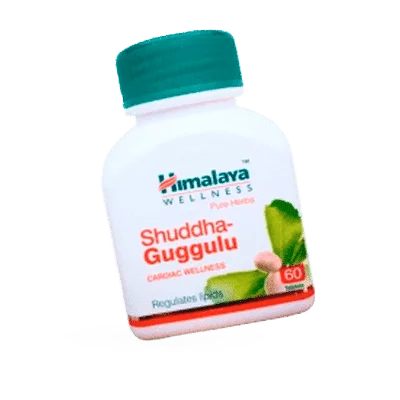
Shuddha Guggulu is a purified Ayurvedic resin from Commiphora wightii containing guggulsterones. It is for adults seeking metabolic and inflammatory balance as part of diet and activity routines. It supports lipid metabolism pathways and may help maintain healthy lipid levels and joint comfort.
Description
Shuddha Guggulu is the purified form of Guggulu resin obtained from Commiphora wightii (also referenced in commerce and literature as Commiphora mukul). In Ayurvedic practice, “Shuddha” signals that the raw resin has been processed to improve tolerability and remove excess irritants, so it can be used more comfortably in longer courses.
Guggul has a long history in classical Ayurvedic texts as a “resin medicine” used for issues linked with stiffness, swelling, sluggish digestion, and “lipid heaviness.” In modern terms, many people reach for Shuddha Guggulu when they want help maintaining joint mobility, cardio-metabolic parameters, and a more responsive metabolism while they also work on diet and daily movement.
One practical nuance: purified resin products can still feel “warming” to the stomach in sensitive users, so timing and food choices matter more than people expect.
If your stomach is sensitive, start with a lower frequency (once daily) for 3–4 days before moving to the full routine. This simple step often reduces nausea and loose stools.
Composition
Purified guggul (Commiphora mukul) resin extract containing naturally occurring guggulsterones (E- and Z-). May also include common excipients used for oral formulations, such as a binding agent and stabilizers, depending on manufacturer specification.
Dosage and usage
Shuddha Guggulu is supplied as oral pills in a bottle. A common routine is 1–2 times daily, taken about 30 minutes before meals or around 1 hour after meals, with water. Many Ayurvedic clinicians suggest a multi-week course; longer courses are also used when the goal is lipid and metabolic support.
A practical way to approach it:
Start with once daily for a few days if you’re sensitive.
Move to twice daily if tolerated and if your goal needs it.
Keep timing consistent day to day.
Pair it with a lighter, less oily diet and regular walking or resistance training.
Swallow with water.
Do not double doses.
If you tend to get reflux, take Shuddha Guggulu after food rather than before food, and avoid taking it right before lying down. Many people fix “heartburn from herbs” with timing alone.
How it works
Route: Oral.
Dose: 250–500 mg per dose.
Frequency: 2 times/day.
Timing: After meals (morning and evening).
Duration: 6–8 weeks, then reassess need.
Maximum without medical advice: Do not exceed 1,500 mg/day.
If using topical form (if applicable): Apply a thin layer to the area 1–2 times/day for up to 14 days; avoid broken skin.
Indications
Shuddha Guggulu is used in Ayurveda as a supportive option for lipid balance, metabolic health, and joint comfort. On many product pages you’ll see statements such as Shuddha Guggulu helps support Healthy Lipid Levels; this reflects its traditional positioning for “meda” (lipid/fat metabolism) support and its studied guggulsterones’ interaction with lipid pathways.
In clinical discussions, I usually frame the potential benefits like this:
Lipid profile support: Shuddha Guggulu is commonly taken to support healthier LDL and triglyceride patterns as part of a nutrition plan. Evidence quality varies by study design and extract standardisation, which is a real limitation with botanicals.
Weight-management routines: People often use it to support metabolism while they reduce refined carbohydrates and increase activity. It is not a standalone weight-loss tool, and results tend to be subtle and slower than many expect.
Joint comfort: Anti-inflammatory and antioxidant actions may support day-to-day comfort, especially when stiffness is linked with metabolic inflammation.
A short, honest drawback: if your thyroid function is already unstable, Shuddha Guggulu can be a tricky fit because it may push thyroid activity in some users, and symptoms can swing either way.
This is a “routine” supplement.
Expect gradual change.
Shuddha Guggulu means the purified resin. Guggulu is the broader term for the resin itself, and in day-to-day conversation people may use Guggul and Guggulu interchangeably.
Formulas like Gokshuradi Guggul, Kaishore Guggul, Mahayograj Guggulu, and Kanchnar Guggulu include Guggulu plus other herbs (and sometimes ghee-based carriers). Those added ingredients aim the formula toward a specific pattern—urinary support for Gokshuradi, inflammatory-joint patterns for Kaishore, deeper musculoskeletal support for Mahayograj, and glandular/kapha patterns for Kanchnar—while Shuddha Guggulu stays closer to a single-herb approach centered on resin actives.
A useful buyer’s lens: choose Shuddha Guggulu when you want a simpler routine and clearer feedback on tolerability, since multi-herb blends make it harder to identify what helped and what caused side effects.
Avoid Shuddha Guggulu if you have ever reacted to guggulu resin, or if you are pregnant or breastfeeding. It is also a poor fit if you currently have ulcer-type stomach pain or significant gastritis, because it can aggravate gut irritation.
Be cautious or seek clinician guidance if you have thyroid instability, take blood thinners, or use medicines for diabetes, since thyroid symptoms, bleeding tendency, or low blood sugar patterns may shift after starting it.
Side effects
Most side effects reported with Shuddha Guggulu involve the gut. Nausea, stomach discomfort, and diarrhoea are common “early signals,” and they often settle when the routine is adjusted. Headache or dizziness can occur, more often when people take more than they intended.
Skin reactions can happen. Rashes and itching suggest sensitivity and should be taken seriously.
Thyroid effects are the side effect people miss. If you develop new heat intolerance, tremor, restlessness, or unexpected fatigue and weight change, the thyroid angle needs attention because Shuddha Guggulu may influence thyroid activity in some individuals [2].
People with diabetes should also be careful, because blood glucose may drop more than expected when Shuddha Guggulu is combined with glucose-lowering medicines or aggressive dieting.
Common mistakes
Small errors can make an herbal routine feel disappointing.
Changing timing every day: Metabolic and thyroid-related sensations can fluctuate, and inconsistent timing makes it hard to interpret what’s going on.
Stacking multiple “fat-burner” or thyroid-support supplements: This is where jitteriness, palpitations, and sleep disruption show up.
Ignoring gut side effects: Mild nausea or looser stools are often a signal to reduce frequency or switch to post-meal dosing, not a sign you must stop immediately.
Using it as a substitute for lipid therapy when risk is high: If you already have established cardiovascular disease, Shuddha Guggulu can be supportive, but it is not a replacement for clinician-guided care.
If your goal is lipid support, plan a lab check after 8–12 weeks of consistent use. Guessing from symptoms is unreliable for cholesterol.
What doctors say
In day-to-day practice, clinicians who are open to Ayurveda tend to use Shuddha Guggulu for metabolic pattern support, not as a replacement for lipid-lowering medicines when those are clearly indicated. Doctors also see that the biggest wins come from pairing it with a realistic diet plan that patients can follow for months, not days.
What doctors often observe in real patients:
When people take Shuddha Guggulu on an empty stomach while also drinking strong coffee, they report more reflux and cramping.
People who track labs (lipids, thyroid markers, fasting glucose) get clearer answers than people who judge results by “feeling” alone.
If a patient is on levothyroxine, dose timing can become messy when Shuddha Guggulu is added, because thyroid symptoms may shift before the lab values do.
If you use levothyroxine, keep a consistent gap between it and Shuddha Guggulu every day. Mixing timings randomly is a common reason people feel “wired” one week and flat the next.
Frequently asked questions
Do you offer anonymous delivery?
Your order will be securely packed and shipped within 24 hours. This is exactly what your package will look like (images of an actual item sent). It has the size and look of a regular private letter (24x11x0.7 cm) and its contents cannot be seen.
Shuddha Guggulu is also used as a core component inside many classic combinations. These combinations are designed around different Ayurvedic goals, and the added herbs or ghee-based carriers change how the formula “behaves” in the body.
Digestion support and metabolic “clearing” routines
Kaishore Guggul / Kaishore Guggulu
Joint comfort patterns linked with heat/inflammation
Kanchnar Guggulu / Kerala Ayurveda Kanchanar-Gugulu
Glandular/neck swelling patterns in Ayurveda and “kapha” balance
These are distinct formulas with multiple botanicals. Shuddha Guggulu refers to the purified resin itself, which is also used as a base ingredient inside many of them.
Shuddha Guggulu: Reviews and Experiences
R
R., 41
Dubai
8 weeks
Verified
Rating: 4.5 out of 5
I used Shuddha Guggulu for lipid support while I cut fried foods and started walking after dinner. By week 3 my digestion felt lighter, and my morning stiffness eased a bit. The first week I had mild nausea when I took it before breakfast, so I moved it to after meals and it was fine.
13 Nov 2024
S
S., 36
Abu Dhabi
4 weeks
Verified
Rating: 3.5 out of 5
I wanted weight support. I didn’t see a dramatic change on the scale, but my cravings were calmer and I felt less bloated. Sleep was normal. I kept it once a day because twice a day gave me loose stools.
22 Nov 2024
M
M., 52
Sharjah
2 weeks
Verified
Rating: 5 out of 5
I stopped early because I felt jittery and my heart rate was higher at night. I have a history of thyroid fluctuations, and looking back that probably wasn’t the right match for me. The stomach side effects were minor, but the restlessness wasn’t.
10 Dec 2024
N
N., 29
Ajman
6 weeks
Verified
Rating: 4 out of 5
Joint discomfort in my knees improved after about a month, most days at least. I did get a mild skin itch on my forearms in week 2 that settled without treatment. I wouldn’t take it on an empty stomach again.
6 Dec 2024
Sources
European Medicines Agency (EMA) (2026). Herbal medicinal products: quality, safety and efficacy considerations for traditional herbal preparations.
World Health Organization (WHO) (2026). WHO monographs on selected medicinal plants: safety information and adverse reaction patterns.
MOHAP (Ministry of Health and Prevention, UAE) (2026). Guidance on safe use of health products and managing interactions with chronic medicines.
World Health Organization (WHO) (2025). WHO global report on traditional and complementary medicine: clinical use, safety, and quality.
National Center for Complementary and Integrative Health (NCCIH) (2026). Herbal supplements: safety, interactions, and quality considerations.