موثّق
I took 0.5 mg twice a day for a gout flare, and the pain started easing within a day. Mild stomach upset showed up, but it was manageable with food.
23 Oct 2024

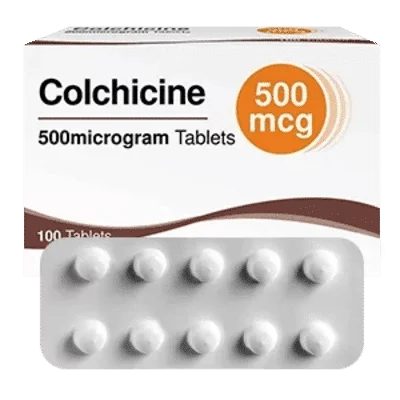
Colchicine is an oral anti-inflammatory medicine for adults with gout flares or Familial Mediterranean Fever. It helps reduce crystal-driven inflammation and inflammatory attacks without lowering uric acid itself.
Colchicine is an oral anti-inflammatory medicine used to treat and prevent gout flares and to manage Familial Mediterranean Fever (FMF). It is used in adults who need fast control of crystal-driven inflammation or FMF-related inflammatory attacks. The key benefit is that it calms the inflammatory cascade without lowering uric acid itself.
Each Colchicine tablet contains colchicine as the active substance. It may also include standard tablet excipients such as lactose, starch, cellulose, povidone, and magnesium stearate, depending on the manufacturer. The medicine is taken by mouth as tablets for systemic anti-inflammatory action.
Colchicine on this page is supplied as 0.5 mg tablets for oral use.
Typical adult dosing patterns clinicians use include:
Colchicine has a narrow safety margin. Dose discipline matters.
If a dose is missed for prevention (gout prophylaxis or FMF), the usual approach is to take it when remembered unless it is close to the next scheduled dose, then continue the regular schedule. Doubling up raises the risk of gastrointestinal intolerance and toxicity.
Swallow tablets with water. Food can reduce stomach upset for some patients, but it can also delay onset slightly during a flare. If nausea is your main issue, taking the dose with a small snack often helps.
Colchicine works by dampening the immune “traffic” into an inflamed joint or inflamed tissue. It binds to tubulin and disrupts microtubule polymerization, which neutrophils need to migrate, engulf urate crystals, and amplify inflammation. In plain terms, fewer activated white blood cells reach the target, and less inflammatory signalling is released.
The same biology explains why Colchicine helps in both gout and FMF. Gout inflammation is triggered by monosodium urate crystals. FMF is driven by innate immune dysregulation. In both cases, Colchicine can reduce the intensity and duration of inflammatory attacks by limiting neutrophil-driven amplification.
One limitation matters. Colchicine does not remove uric acid from the body, so it does not replace urate-lowering therapy when that is indicated for gout control over months and years.
Colchicine is used for:
Colchicine has a specific lane in gout care: it is aimed at inflammation control during flares and flare prevention in selected situations. It does not lower urate. NSAIDs reduce pain and inflammation too, but they bring GI, kidney, and cardiovascular limitations. Allopurinol lowers urate for long-term control, but it is not a flare “rescue” medicine.
| Option | Main role in gout | Key trade-off |
|---|---|---|
| Colchicine | Acute flare treatment; flare prevention in selected patients | GI effects and toxicity risk with interactions or organ impairment |
| NSAIDs (e.g., ibuprofen/naproxen) | Acute flare symptom control | GI bleeding risk, kidney strain, BP/cardiac considerations |
| Allopurinol | Long-term urate lowering to prevent future flares | Needs titration; flares can occur early; not for immediate pain relief |
A change clinicians have leaned into in recent years is low-dose colchicine strategies for flares rather than older high-dose approaches, because similar symptom control can be achieved with fewer adverse GI outcomes in many patients. The “best” option depends on kidney function, ulcer history, cardiovascular risk, and interaction profile, not just how painful the flare feels that day.
Colchicine is not a good fit if you have severe kidney problems, a colchicine allergy, blood cell disorders, or if you are pregnant and do not have specialist advice. Extra caution is needed in older adults, people with stomach or bowel problems, liver or heart impairment, or anyone with a history of muscle problems. It also needs careful review if you take medicines that can raise colchicine levels.
Colchicine commonly causes gastrointestinal (GI) effects such as nausea, vomiting, abdominal cramping, and diarrhoea, and this is the most frequent reason people stop or reduce treatment. This GI pattern is also the earliest signal clinicians watch for when assessing colchicine toxicity [2].
Common side effects people report:
Serious or clinically urgent effects (more likely with higher exposure, interactions, or kidney/liver impairment):
Toxicity can be severe and can progress quickly. If someone develops severe GI symptoms plus marked weakness, faintness, muscle pain, or new bleeding/bruising after taking Colchicine, clinicians treat it as a medical emergency scenario.
These are patterns I see repeated with Colchicine, and they are avoidable:
In clinical practice, doctors often observe that Colchicine works best when the flare is treated early and dosing is kept inside a strict safety boundary. People who “push through” diarrhoea often end up stopping the medicine completely, while those who adjust early can still get the anti-inflammatory benefit. Clinicians also see confusion between Colchicine and urate-lowering therapy; patients may expect it to “fix uric acid,” then feel disappointed when attacks recur without a long-term urate plan. For FMF, adherence is the make-or-break factor, because missed daily doses can allow attacks to return and can reduce protection against long-term complications.
Rheumatology and internal medicine teams in the UAE commonly use Colchicine as a targeted anti-inflammatory tool when NSAIDs are risky or when flare prophylaxis is needed during urate-lowering changes. EMA-aligned precautions guide the big decisions: avoid high-risk interactions, reduce dose in renal/hepatic impairment, and take GI side effects seriously as an exposure signal. WHO pharmacovigilance principles also shape practice: when severe adverse effects occur, clinicians assume an interaction or impaired clearance until proven otherwise [4].
Alcohol can worsen gout by increasing urate production and triggering flares, so it works against the goal even if it does not directly cancel Colchicine. Alcohol also irritates the stomach and can amplify nausea and diarrhoea, which are already the main Colchicine side effects. If Colchicine is being used for an acute flare, many clinicians advise avoiding alcohol until symptoms settle and GI tolerance is clear. In 2025, the NHS patient information page on colchicine highlighted practical flare triggers and gastrointestinal tolerability as key issues.
Symptom relief can begin within a few hours, with the best results when the dose is taken early in the flare rather than after a full day of swelling. The speed depends on how established the inflammation is, your GI absorption, and whether dosing is limited by side effects. If pain is worsening after the initial regimen, clinicians usually reassess the diagnosis and consider another anti-inflammatory strategy rather than escalating Colchicine repeatedly. In 2025, the European Medicines Agency noted that dose limits matter because toxicity risk rises faster than benefit when dosing is pushed.
For prevention dosing (gout prophylaxis or FMF), the common approach is to take the missed dose when remembered unless the next dose is due soon, then return to the regular schedule. Doubling the dose is a frequent cause of sudden diarrhoea and cramps. If multiple doses were missed in FMF and attacks restart, doctors often restart the usual daily plan and monitor response rather than “catch up” aggressively. In 2025, the World Health Organization reinforced the importance of avoiding double dosing with narrow-therapeutic-index medicines.
Early colchicine toxicity often starts as severe GI upset: profuse diarrhoea, repeated vomiting, and cramping that feels out of proportion. Red flags that raise urgency include marked weakness, dizziness, fainting, confusion, muscle pain, or new bruising or bleeding. Toxicity risk increases with kidney or liver impairment and with strong CYP3A4 or P-gp inhibitors. In 2025, the European Medicines Agency described this exposure-toxicity pattern and the need for strict dosing discipline.
Yes, they are often used together in gout management, because allopurinol lowers urate long-term while Colchicine helps prevent or treat flares during transitions. The practical issue is planning: starting or increasing allopurinol can trigger flares early, so prophylaxis choices matter, and kidney function influences dosing of both medicines. The clinician’s focus is also on interaction burden from the rest of the medication list, not only these two drugs. In 2025, NICE gout recommendations discussed urate-lowering therapy and flare prophylaxis as linked decisions.
No, Colchicine does not lower uric acid and does not dissolve urate crystals directly. It reduces the inflammatory response to crystals, which is why pain and swelling can improve even while urate remains elevated. For repeated gout attacks or tophi, long-term urate-lowering therapy is the tool that changes urate levels over time. In 2025, the NHS patient information page presented Colchicine as an anti-inflammatory option rather than a urate-lowering medicine.
سيتم تغليف طلبك بشكل آمن وشحنه خلال 24 ساعة. هذا هو الشكل الذي ستبدو عليه طردك بالضبط (صور لمنتج فعلي تم إرساله). له حجم ومظهر رسالة خاصة عادية (9.4×4.3×0.3 بوصة أو 24×11×0.7 سم) ولا يمكن رؤية محتوياته.
